Wednesday, March 28, 2012

The Invisibility Generator

The White Noise GeneratoLinkr
Allies near this this device are fully cloaked while perfectly still. They shimmer while moving, and fully decloak while taking any action. Swing a melee weapon, spin up, scope, taunt, even reload, and you lose your cloak. Medics are excepted from this rule--they can heal while cloaked but cannot activate an ubercharge.

Except for the WNG itself, buildings are not protected by its cloak. The WNG is invisible to enemies at ranges exceeding 150HU, except for spies, who can always see it.

Jarate and mad milk short it out for five seconds unless it's repaired.

Level 1:
100HU of cloaking coverage
20s on decloak cooldown
5HPPS healing

Level 2:
150HU of cloaking coverage
15s on decloak cooldown
7HPPS healing

Level 3:
200HU of cloaking coverage
10s on decloak cooldown
10HPPS healing

Saturday, March 17, 2012

The Teleporter Ray

The Teleporter Ray
Engineer Secondary

Fires a projectile that deals 30 damage
Alt-fire: Teleport to your projectile's location

The gun's projectile basically builds a 100 x 50 x 50 teleport cage when it explodes. There's a team-colored glow and particle effect and shortly after the projectile explodes the Engineer arrives in its place.

The projectile and subsequent teleportation effect should be relatively slow: the weapon doesn't allow Engineers to move much faster than they already can over long distances, but it could potentially allow them to show up in places where nobody would expect them.

I had the idea that it would insta-kill on arrival, which someone pointed out basically makes it an OHK detonator. Unless you miss, at which point you just disoriented yourself near an enemy you thought was worth risking the OHK, i.e. someone unlikely to move out of the way, i.e. a Heavy. And if you do miss, he's going to turn you into chum.

Wednesday, March 14, 2012

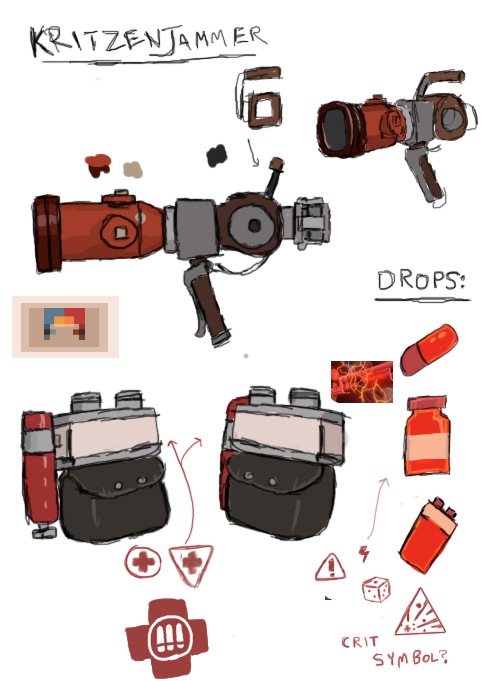
The Kritzenjammer

The Kritzenjammer
Level 5 Medigun
On Damage Assist: Fill secondary bar
When secondary bar is full: Medic drops critz-pill
Uses Kritzkrieg ubercharge
On Wearer:-25 health

Concept Art

I've had an idea like this rolling around since critical pumpkins were introduced back in 2009. In this case, it's sort of an analog to the alt-fire Medkit idea people have propped up a couple times on this forum; only in this case the Medic drops a 3.2 second critical pill periodically.

I'm not sure if these stats are the best fit for the mechanic, and I'm pretty sure that adding this ability to the regular Kritzkrieg and just dropping 25 health isn't enough of a separation. How to fix it is the conundrum.

Monday, March 12, 2012

Why Aren't Medics Overpowered


In the last few months, I've heard something I never thought I'd hear: "Are Medics Overpowered?" Speaking as someone who plays as the Medic frequently, this is a pretty surprising allegation, because the class is challenging and frustrating. A lonely Medic is fodder, often an easy target to a ravening Soldier or Scout. So the idea that someone might consider the Medic to be overpowered seems shocking on its face, and users in the SPUF forum seem to agree.

However, the guys who start these conversations have a pretty obvious answer, one that should give their detractors pause: it is no unquestionable fact that the Medic is widely considered the most powerful character in the TF2. Developers, game critics, and players agree that he will change the course of the game and that fate favors the side with a stern Kraut riding Medigun.

Now, figuring out how the Medic can be important enough to be the factor in figuring out whether a team is going to win or lose without being important requires that his playstyle and role be examined within the game environment. It is not that hard, really: the Medic is the game's only healing class. He does something that no other class does.

The other eight classes more or less play a variation on a theme: dealing damage to minimize enemy presence. A team will do a certain amount of damage per second, based on what their mix of classes are, how good the individual players are, and how long individual players can interact with enemies. The team has a finite amount of attention, which must be split between every available target. The fewer the available targets, the more attention each individual target warrants.

An ally who dies or retreats for health creates "downtime", time when they're neither dealing nor absorbing damage. It's a natural side effect of gameplay, as people must die for the game to progress. A Medic automatically has some standard downtime (since he'll almost never be dealing damage), but presumably the amount of potential damage he generates by preventing allies from dying more than makes up for that.

Being overpowered, of course, depends on the definition of overpowered. An overpowered enemy might be one who can accomplish a great deal for relatively little effort, or an exploit which allows a team with a certain composition to win every time. A medic multiplies the skill of his teammates, allowing them to live longer and deal more damage in a match, but the less effective his allies are, the less effective he is.

Saturday, March 10, 2012

Nailbomb Launcher Unlock


The Hurt Locher
Level 10 Nailbomb Launcher

Nailbomb Stickies shoot straight ahead.
-60% splash

Nailbomb stickies, rather than exploding in large splashy explosions, fire a tight configuration of nails straight out. The Demoman owner sees a team-colored line shooting straight out, identifying their effective range.

Nailbomb stickies automatically hurt people walking over them for about 10 damage.

Nailbomb stickies minicrit on headshots.

Wednesday, February 29, 2012

The Terrible Heal/Hurt Gun

Long ago, some guy had a brilliant idea. They were going to play Uber Game's Monday Night Combat. A class-based third person shooter that's actually a lot of fun to play. Well, the demo is, anyway. That's what I played and that's what I liked.

The game has a class known as the Support, an overweight Italian-sounding fellow who takes the roles of both the Engineer and the Medic to serve as the game's primary support character. Which explains his name, I guess.

In any case, he came armed with a unique primary weapon: the Heal/Hurt gun. It does exactly what it sounds like: it heals and overheals allies, and hurts enemies. A little toggle twitched in the guy's brain. This heal/hurt gun, it heals people! It's exactly like the Medigun! But it also hurts them. So it's better than the Medigun! Why not give the Medic a heal/hurt gun? The "hurt" action will behave exactly like the heal action, but it'll attach to enemies and hurt them for damage equivalent to reverse healing. What's so bad about that?

The most obvious answer is that an inversed medigun would do terrible damage. 24DPS? That's miserable. The solution is to up the damage, but how much? It's a weapon that latches on to the victim. It's actually less challenging to aim than the flamethrower, so it couldn't be that much. Time spent hurting instead of healing is time that could be spent healing, or living to find more patients in need of healing. Realistically, time spent hurting ends in time spent sitting in spawn, thinking about how close you were to killing the guy currently wearing your blood as decorative face paint.

Of course, the Medigun also has to lose something in order to gain any sort of combat ability. So people start by reducing the amount of health the medigun can heal. Usually, they move on to swapping out the ubercharge. Of course, the hurt function isn't like the ubercharge. There's no conflict between healing and ubercharging. You're still doing the same job. Healing and hurting, however, are opposites and require you to focus on two very different targets. Realistically you can only be doing one at a time, even if you could technically be doing both.

Ultimately, there's no reason for a heal/hurt gun to exist. The Medic has a hurting gun: it's his sidearm, the Syringe Gun. Giving him a second hurt gun, one that's meant to be sidegraded against a pure-healing weapon, is invariably going to be bad at healing and certainly can't match the syringe gun for damage output or range. By dividing the gun's goals, it's made weaker on both fronts.

Tuesday, January 31, 2012

History of a Weapon: Quick-Fix


The experimental Field Combat Healing Device (code-named the "Quick Fix") was the first battlefield-ready prototype of the now-standard line of TF-1968 combat Mediguns. Developed in secret at an undisclosed location in the Thunder Mountains, it remains a remarkable piece of field medic technology.

Like the now ubiquitous TF-1968, the Quick-Fix consists of three basic components: a medicinal reactor backpack, handheld beam emitter, and in-patient beam reciever. Accounts from the battle during its initial test case report that the invulnerability charge worked successfully for nearly thirty seconds before the glass casing of the barrel cracked, jamming the feed hose and permanently shorting the machine's ability to generate ubercharge.

The Quick-Fix was considered to be a vital asset and as a result was put into immediate mass production, with further testing to be done with field trials. Field trials discovered, however, that the guns were excessively unstable in combat. The glass casing was prone to cracking as charged notdeadium fluid experienced rapid pressure fluctuations. In short, the machines often exploded.

Experimental retrofitting to combat explosions became commonplace amongst field medics. It was soon discovered that adjusting the gain in the machine's feedback loop primed the uber coil faster and sped patient recovery. Depressurizing the fluid while the circuit was active generated the uber field, but without the high-pressure gain the field was no longer capable of stopping bullets. The less rigid field had a unique property, however: external kinetic energy couldn't penetrate it.

Although the machine now healed faster and would no longer explode while venting its uber circuit, the open-faced vent and unshielded reactor continued to cause problems: medics using the machines would occasionally become inexplicably faster. The closed-face radiator vent decreased energy waste, allowing healed patients healed by the device to generate an "overheal" effect, which protected them from wounding briefly even when no longer exposed to toxic healing radiation.

It was in conjunction with the discovery of a superior casing material for the handheld emitter that the Quick-Fix was abandoned, to be replaced by the newly developed TF-1968 Medigun.